Case Study
Microsoft Business Central Implementation
A growing food trader built a solid digital core with Dynamics 365 Business Central to streamline and scale operations.
A Crux of the Case Story: How a Startup Gained Control Before Growth
A newly registered European trading firm, dealing in cross-border food products, found itself at the starting line with fast-moving operations but without a reliable system to hold it all together.
It had bold ambitions but limited internal structure. Through a collaborative effort with Dynamics Square, it traded manual guesswork for measurable accuracy, aligning processes and financial control before scaling.
Business Overview
The client is a startup trading company focused on food products. Its primary operations take place across Europe, with key management based out of the United Kingdom. The business was set up to work through multiple legal entities. At the time of this engagement, it had already registered two legal companies in Denmark and one in the United Kingdom.
As a newly formed company with global ambitions, the client was aiming to establish operational control across sales, finance, purchasing, inventory, and compliance functions. The trading cycles involved were complex and often time-bound. Without a structured system in place, the business faced the risk of relying on manual coordination for highly regulated transactions.

What are The
Business Challenges
Being in its early stages, the business was trying to grow while still putting its internal structure in place. This led to key gaps across teams, tools, and time:

- Manual entries and patchwork tools made it harder to maintain accuracy.
- Finance reporting lacked real-time visibility, slowing decision-making.
- Multiple legal entities created confusion around transactions and consolidation.
- There was no central platform to align purchase, sales, and stock data.
- International trade rules required tighter controls across locations.
- Rapid operational needs clashed with the absence of scalable systems.
- Remote work was difficult due to limited access to core business tools.
What the Business Needed
At its core, the business needed a structured and scalable system. It had to align people, processes, and data across three registered entities and an expanding trade footprint. The team wanted a single, dependable system that could grow as they grow.
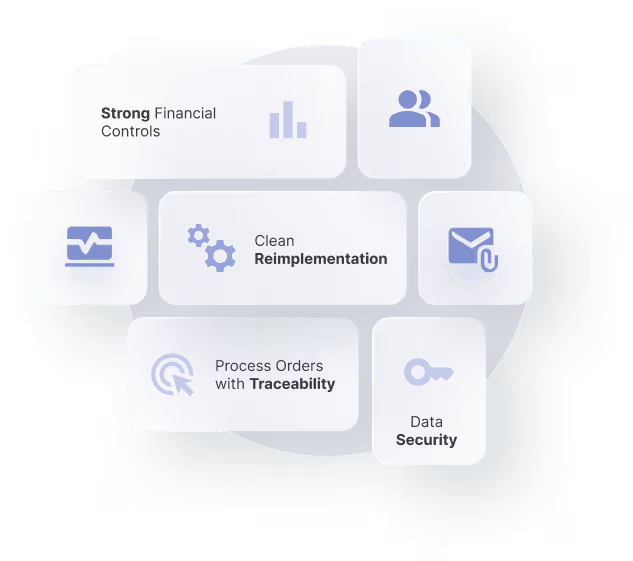
A modern ERP system that works across entities and locations
Ability to process sales and purchase orders with traceability
Strong financial controls and real-time tracking of performance
Seamless connection with Microsoft 365 tools to improve collaboration
Data security with minimal manual work
Reporting that reflects actuals, not estimates
Clarity across finance, inventory, purchasing, and compliance
They needed someone who could travel the distance, both literally and technically, to build something solid and sustainable.
Business Objectives
The business had a clear list of outcomes that it wanted to achieve through the ERP implementation. These goals were designed to create a strong foundation and allow for seamless business expansion in future phases.
Automate routine functions in sales, purchasing, finance, and stock management
Gain better visibility of financial health for faster decisions
Improve accuracy and reduce wastage across inventory
Manage customer data in a single space to improve service
Strengthen sales operations with tools to manage interactions
Ensure compliance and data protection across legal entities
Identify areas of operational growth through better reporting
Prepare for expansion into other markets and jurisdictions
Allow staff to work securely from different locations and time zones
Solutions Proposed by
Dynamics Square
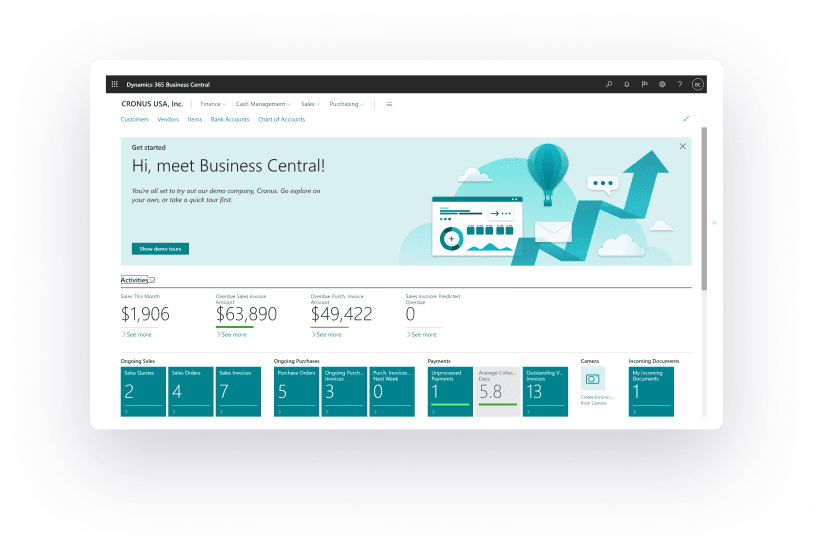
The project called for a well-paced, end-to-end ERP deployment that fits the startup’s current scale and future demands. Dynamics Square proposed the implementation of Microsoft Dynamics 365 Business Central. The project was planned using a blend of remote and onsite efforts, depending on project milestones.
Core ERP Modules Included:
Finance (General Ledger)
Chart of accounts, currency set-up, journal entries, VAT tracking. Financial statements and reports, G/L budgets, and year-end closure.
Sales and Receivables
Customer master, order management, sales invoices and credit notes. Sales journals, customer statements, and receivables reporting.
Purchasing and Payables
Vendor master, purchase order workflows, returns, quotes, and invoices. Payables reports and purchase-related documentation.
Inventory Management
Item master, variants, stock transfers, lot and serial tracking. Requisition worksheets, costing, and inventory reports.
Fixed Assets
Depreciation planning, asset journals, purchase and sale of assets. Registers for tracking and audit purposes.
Cash and Bank Management
Bank reconciliation, deposit handling, and payment journals.
Project Execution Methodology
Planning and Project Kick-off, Analysis and Fit-Gap Sessions, Design and Configuration, Deployment and User Training, Post-Go Live Support.
Support Plans Offered
Five-day post-go-live support to address minor issues or errors. Prepaid support hours with priority-based service windows.
Additional Requests Addressed
The client required a user manual and associated cost clarity. HR add-on solutions discussed for future roll-out. Office 365 licensing included for the newly registered entity. Revised proposal to include two Danish and one UK legal entity. Future entity in Turkey planned for Phase Two.
Results and Impact: What This Transformation Means
Speaking of the impact of this digital transformation, some of the early shifts and projected results include:
Stronger Retail Operations
Retail counter transactions, inventory tracking, and vendor coordination expected to become faster and error-free.
Digitally Synchronized Warehouse
A hybrid warehouse model that blends robotic automation with mobile warehouse management, improving picking and dispatch accuracy.
Decreased Dependency on External Developers
With core processes handled by Business Central, the business moved away from fragile middleware dependencies.
Reliable Reports, Faster Decisions
Daily insights across categories and vendors equipped managers with better control over stock, pricing, and promotions.
Improved Vendor Management
Automated purchase order processes and document handling improved vendor relationships and reduced delays.
End-to-End Visibility
All sales channels, inventory points, and warehouse movements connected in one central system.

Consult To Reveal Best Approach
Connect with us to facilitate your system to drive a parallel approach in the market you deal with. We help enterprises to implement their unique needs.
Schedule a DemoWhy This Case Matters and Future Prospects
This story stands as a clear example of how a startup, when supported with the right technology and guidance, can build clarity before complexity takes over. It reflects how businesses with small teams and big goals can unlock their full potential when their systems work for them, rather than around them.
Phase Two will include the addition of a Turkish legal entity and expansion of features like HR add-ons and extended analytics. For now, the business has made its first strong step, one that balances structure with flexibility and speed with stability.